



An escape game to raise awareness amongst secondary school pupils about the work of the gendarmerie
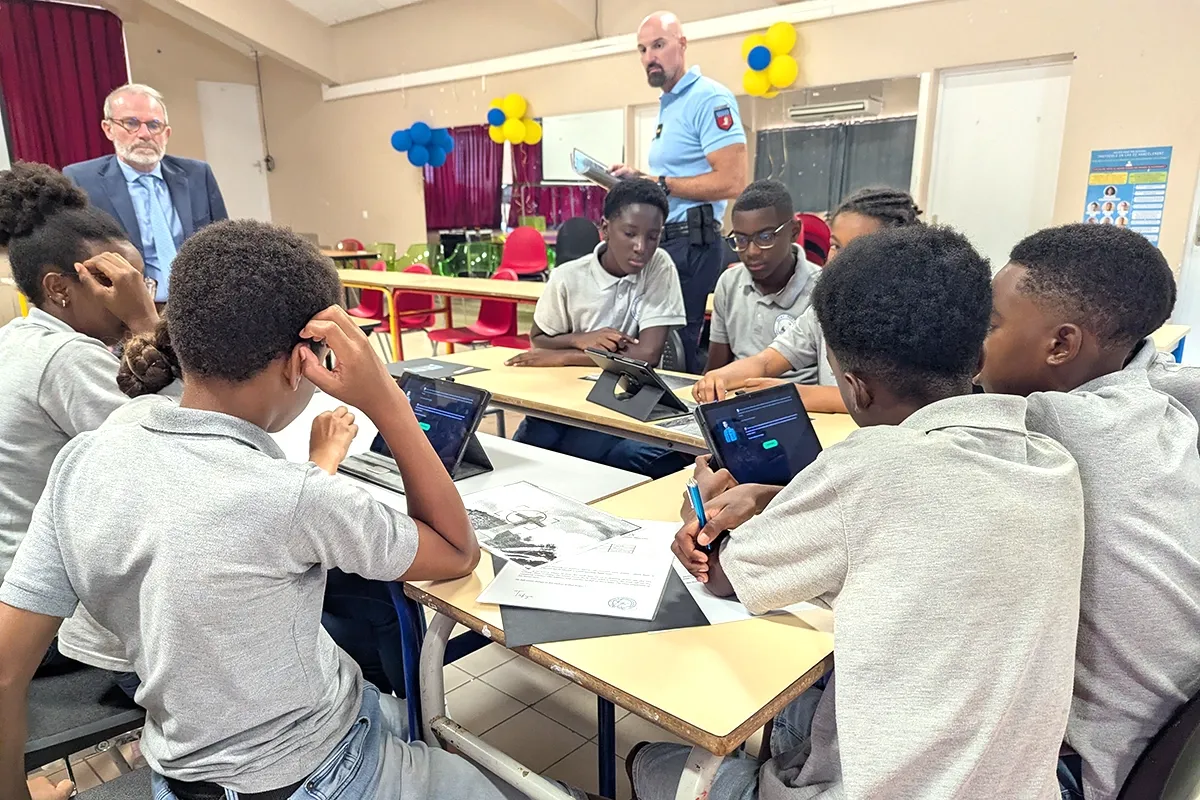
On Friday 19 June, nine Year 7 pupils from Mont des Accords Secondary School took part in a completely new kind of exercise. Gathered in the multi-purpose hall, they took part in a detective game devised by the National Gendarmerie.
The aim of this escape game is to raise awareness amongst the younger generation about the role of a gendarme and to help prevent crime. Funded to the tune of €16,000 by the prefecture, this innovative tool has been specially adapted for the local area. Having already been trialled in mainland France, the concept incorporates locations and street names familiar to young people in Saint-Martin. Following an initial trial with a Year 7 class at Roche Gravée secondary school in Moho, Quartier d’Orléans, the programme was presented to pupils in Marigot in the presence of Prefect Cyrille Le Vély. “The idea is to raise awareness among the youngest children about issues such as road safety, but also to encourage them to think about what it means to be a good citizen and how to behave appropriately,” emphasised the government representative. Equipped with tablets, the pupils are immersed in a life-size investigation. On their screens, the scenario begins with a road traffic accident involving a scooter that fled the scene after hitting a pedestrian. Divided into teams of three or four per tablet, the pupils represent different units of the gendarmerie. Whether part of the brigade, the rapid response unit or the forensic team, the young investigators must analyse audio recordings and images, or even draw up a composite sketch, in order to identify the suspect. It was an experience the secondary school pupils thoroughly enjoyed. “It was like a big jigsaw puzzle; you had to find the clues to get to the answer,” says Marquis with a smile.
This mental exercise also appealed to his classmate Westley. “You have to work as a team; it showed us how to work in a group,” he says. Indeed, each team must collaborate with its neighbours to make progress in the investigation. The game, designed with bilingual instructions, lasts less than an hour so that it can be easily fitted into the school timetable. For Sergeant Didier, who works at the Family Protection Centre, this tool offers a “fun and modern” approach to prevention. “It helps to open up discussion on certain issues such as violence or bullying and demonstrates an alternative use for digital tools,” says the law enforcement representative. The organisers have deemed the experiment a success and are now planning to roll out this escape game to other schools on the island from the start of the next academic year.