


Air Antilles: regrets, but no remorse
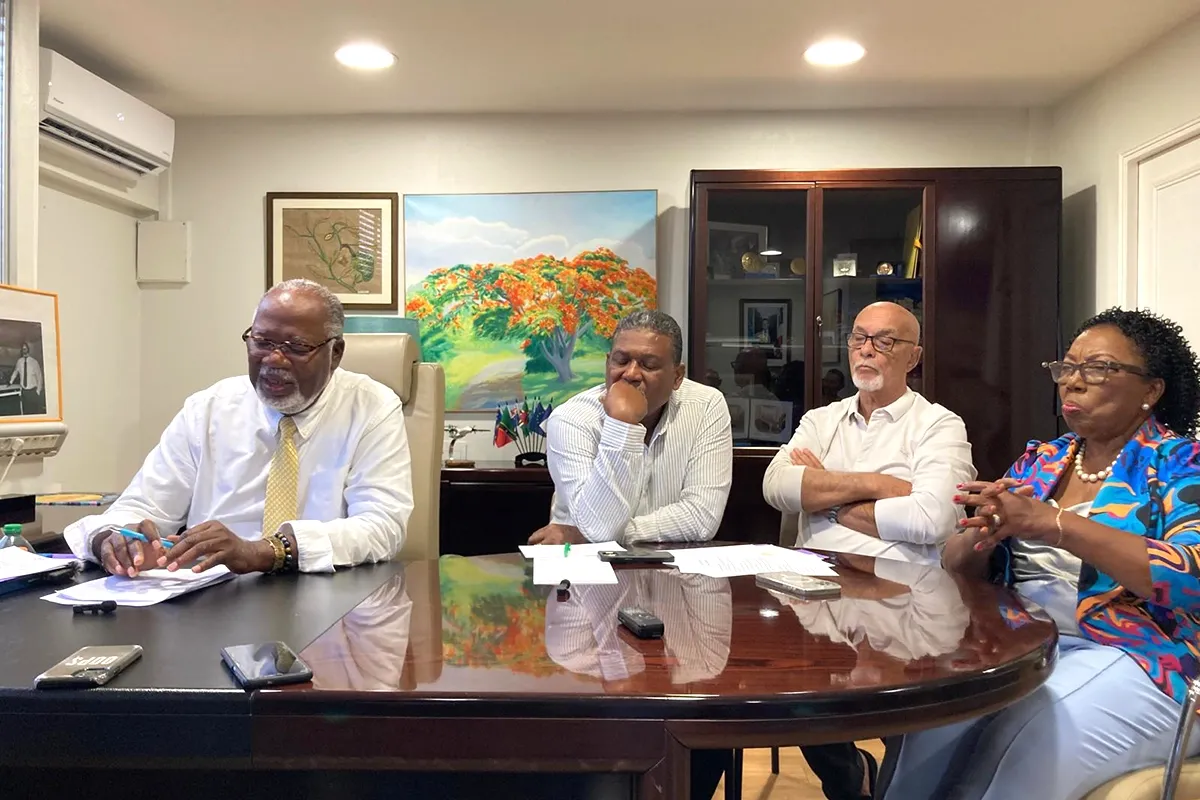
Louis Mussington and three of the vice-presidents—Alain Richardson, Bernadette Davis and Michel Petit—discussed the liquidation of Air Antilles at a press briefing last Thursday. “A heavy blow for the employees and for the Collectivité”, but one that does not call into question the original motivation: to defend territorial continuity and the opening up of the territory, whatever the cost.
“The key point is that we fought right to the end… We needed to maintain the balance of air transport in Guadeloupe, Martinique and Saint Martin, but also across the Caribbean, and ensure that fares remained affordable for ordinary people,” explained Louis Mussington, after a moment’s thought for the employees for whom this is a “hard blow ”. It is also a heavy blow for the Collectivité, which “invested €20 million in the hope of being reimbursed at some point… Unfortunately, that is not the case today,” continued the president, lamenting the lack of support from the State and local authorities.
A failure of public authorities
Louis Mussington effectively denounces a failure of public authorities, regretting that Guadeloupe and Martinique have not kept their promises (amounting to €2.5 million each), despite the fact that the majority of employees are based in their territories. The same criticism applies to the State, despite its knowledge of the negotiations conducted with neighbouring islands to establish a partnership between the Collectivité, Air Antilles and Liat. “None of this was taken into account. The wisdom of the people of Saint Martin in opting for their own status and autonomy to break away from the Guadeloupe archipelago was truly the right choice. I remain convinced that we fought a courageous and just battle, which unfortunately did not succeed,” lamented the president.
“Saint Martin did what had to be done,” Alain Richardson repeated several times, expressing his disappointment and a sense of being a victim in the face of certain people’s indifference. Indeed, for the first vice-president, government support to ensure the survival of certain entities is a necessity, citing Air France, EDF, Renault, CMA CGM and Corsair as examples. But the DGAC’s decisions also played a role, according to the vice-president, who felt that for them the position was clear: Air Antilles was destined to disappear from the outset! “Saint-Martin can consider itself a victim,” because “it was clear that the Collectivité alone could not guarantee the airline’s development, but we shouldered our responsibilities; we took the lead,” concluded Alain Richardson on this point.
A ruling with no consequences
“There will be no consequences, apart from the fact that we have lost 20 million,” the president continued. As for the impact on ongoing projects, and whether his term of office will have the resources to match its ambitions, he was keen to point out that the Collectivité was exploring other sources of funding for the multi-year investment programme: “we will continue to consider various strategies to ensure we have the means to implement our public investment policies”.
As for the upcoming elections, the question arose there too, but for Louis Mussington, “the electorate will continue to make a reasonable and considered choice between stagnation, irresponsibility, the automatic withdrawal of European funds, and the political commitment we have made, and I have no concerns”.
However, the issue of passengers remains, with ticket refunds now in the hands of the liquidator. “The Collectivité will monitor this closely, as these are families who are not exactly rolling in money and who find themselves penalised threefold. We will see how this can be handled and what legal solutions might be available,” said Alain Richardson.
Finally, regarding the much-discussed audit requested by the Collectivité, the report was deliberately kept secret in order “not to discourage potential buyers and to preserve the chances of rescuing Air Antilles”. The President firmly denied the disappearance of €8 million, describing these accusations as unfounded. However, he admitted that the report was damning and clearly highlighted “incompetence, abuses in a number of areas, and a patchwork situation in the sense that it was not real professionals in charge of management”. There was therefore nothing vague about any of this…