



Sargassum: what are others doing?
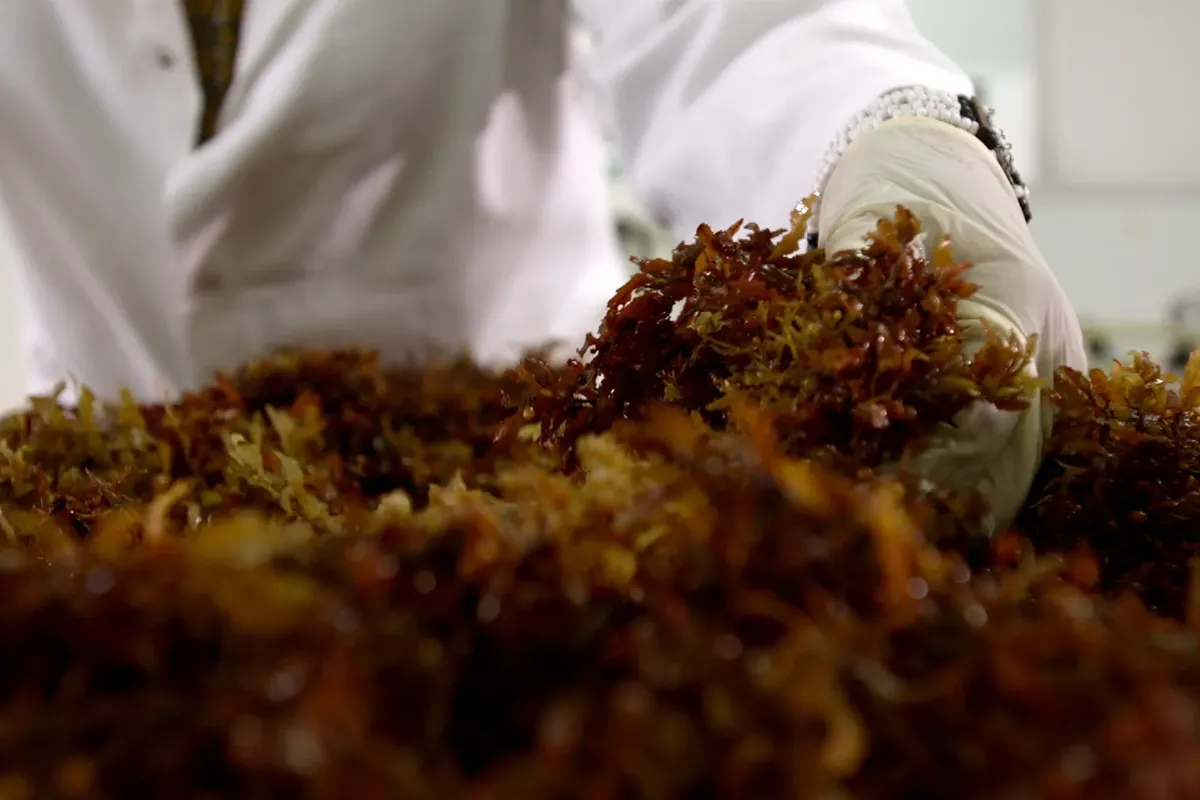
Whilst Sargassum drifts are expected to intensify in the coming weeks, Saint Martin is still working to strengthen its response measures. Elsewhere in the Caribbean, initiatives are multiplying: collection at sea, diversion barriers, regional cooperation and, now, the recycling of the seaweed.
The season is intensifying. Whilst the majority of the filaments are still passing south of the Northern Islands for the time being, strandings are expected to become more frequent over the next two weeks, occurring repeatedly in some areas and resulting in significant accumulations, according to the Météo-France bulletin of 10 August.
In Saint-Martin, the first diversion barriers originally promised for June will finally be installed in August at Cul-de-Sac, with the other two due in the autumn. On land, collection continues to be handled by two contractors, but the current contract was not designed to cope with the full volume of seaweed likely to wash ashore.
Preventing Sargassum from washing ashore
In Mexico, 2026 is considered a record year, with up to 9,000 tonnes washing up on the beaches of Quintana Roo every day. The authorities have decided to invest $150 million in a plan focused primarily on collection at sea. Two 60-metre vessels are to be deployed, whilst the navy is also planning to install nearly 50 km of barriers designed to intercept or divert the Sargassum before it reaches the beaches.
In the French West Indies, Guadeloupe has been trialling this approach of intervening before the seaweed washes ashore for several years, using diversion barriers as well as developing methods for collection at sea. The first Sargator, designed in Guadeloupe by STMI, was capable of recovering 12 tonnes of seaweed directly from the surface. The new Sargator 3, which entered service in March 2026 in Martinique, can collect 100 tonnes of Sargassum per day. Its large front-mounted conveyor belt collects the seaweed, which is placed into big bags handled by a barge fitted with a crane, thus avoiding the need to return to shore. However, the Sargator is designed to form part of a system combining barriers, a collection vessel, a transfer barge and storage capacity. Experience shows that barriers are only part of the solution. They help to retain or concentrate the seaweed, but must be combined with methods for recovering it quickly at sea, before it washes ashore and decomposes.
In Saint-Barthélemy, the strategy also involves diversion barriers. The first section of the system planned for Marigot was assembled on 3 August. Its positioning was determined on the basis of current studies and observations carried out on the water surface. The system can be adapted depending on the behaviour of the sargassum, weather conditions and initial feedback. Similar installations are also planned for Cul-de-Sac and Anse des Cayes.
No longer acting alone
It is now widely recognised that no single island can tackle this phenomenon – which has become massive and recurrent – on its own. The Caribbean islands are now seeking to coordinate their actions more closely. The Organisation of Eastern Caribbean States (OECS), of which Saint Martin is a member, is therefore working on a joint strategy that goes beyond simply collecting and storing sargassum to include its reuse. Following a mission carried out in particular in Guadeloupe and Martinique, the OECS wishes to build on existing experience. Gas monitoring, forecasting arrivals, collection techniques, barriers or economic utilisation: some of the solutions already exist.
Turning a scourge into a resource
For a long time, the main question was how to get rid of Sargassum. Today, the focus is on finding solutions to turn a scourge into a resource. Numerous experiments are underway, with Mexico leading the way by attempting to turn it into agricultural fertilisers and biostimulants, building materials, cosmetics or imitation leather. The United States is attempting to repurpose it as a biosorbent for recovering metals and rare earth elements, whilst Barbados and Grenada aim to convert it into biogas, biomethane and fuel, and Guadeloupe and Martinique into activated carbon for pollution control. However, according to the Inter-American Development Bank (IDB), many projects remain at the pilot stage due to the very rapid degradation of the algae after they wash ashore, their variable composition, the irregularity of supply and, above all, their arsenic content, which constitute major obstacles. According to the IDB, 86 per cent of the samples analysed exceed international regulatory limits for arsenic. Processes exist that can remove more than 97 per cent of it in the laboratory, but their effectiveness on an industrial scale has yet to be demonstrated.
This is the case with the Sargasse Project, set up in 2019 by Pierre-Antoine Guibout in Saint-Barthélemy, which aimed to transform the seaweed into pulp for the manufacture of paper and cardboard. After raising high hopes, the major announcements made between 2020 and 2023 — a pilot plant in Guadeloupe, industrial production and roll-out across the Caribbean islands — have not materialised.
The roadmap, published by the Ministry for Ecological Transition in February 2025, highlighted the difficulties facing recovery projects in the French West Indies: the scale of the facilities, the cost of the installations and the funding required to move from the experimental stage to full-scale production. However, another avenue may be opening up in Saint-Barthélemy. Nicolas Vernoux-Thélot, an architect from the island, is developing a process to incorporate sargassum into concrete for road construction. Following several years of research and laboratory trials, the first full-scale demonstration project was cast on 17 July at the sargassum storage site in Saint-Jean, with the support of the Collectivité de Saint-Barthélemy. The section, measuring 2.70 m by 5.20 m, was constructed using both conventional fibre-reinforced concrete and concrete incorporating pre-treated sargassum. It now remains to be seen how well it withstands the test of time. Samples will be analysed after 7, 21, 28, 60, 180 and 360 days to assess how the material evolves and to compare it with that of traditional concrete. If the results are conclusive, the process could then be adapted for use in various forms: concrete, breeze blocks, paving stones, floor slabs, screeds or mortars.