



Sargassum: a brown tide warning has been issued
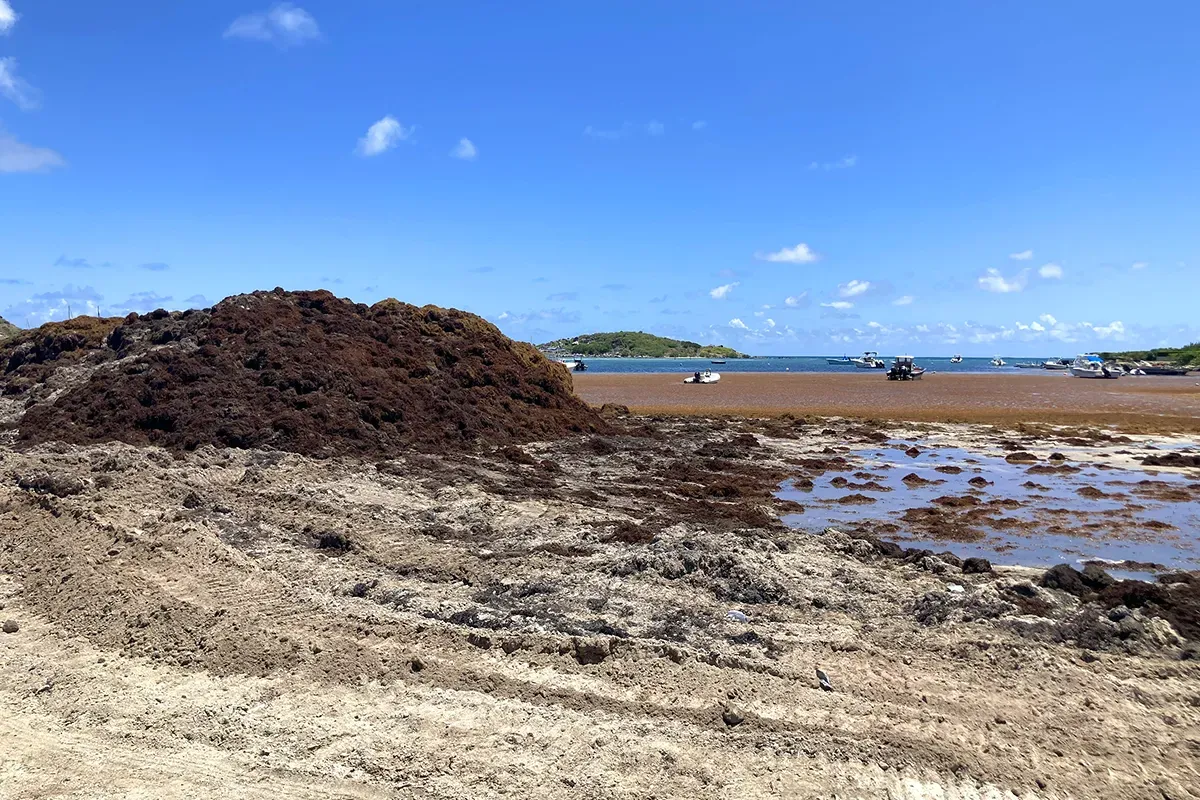
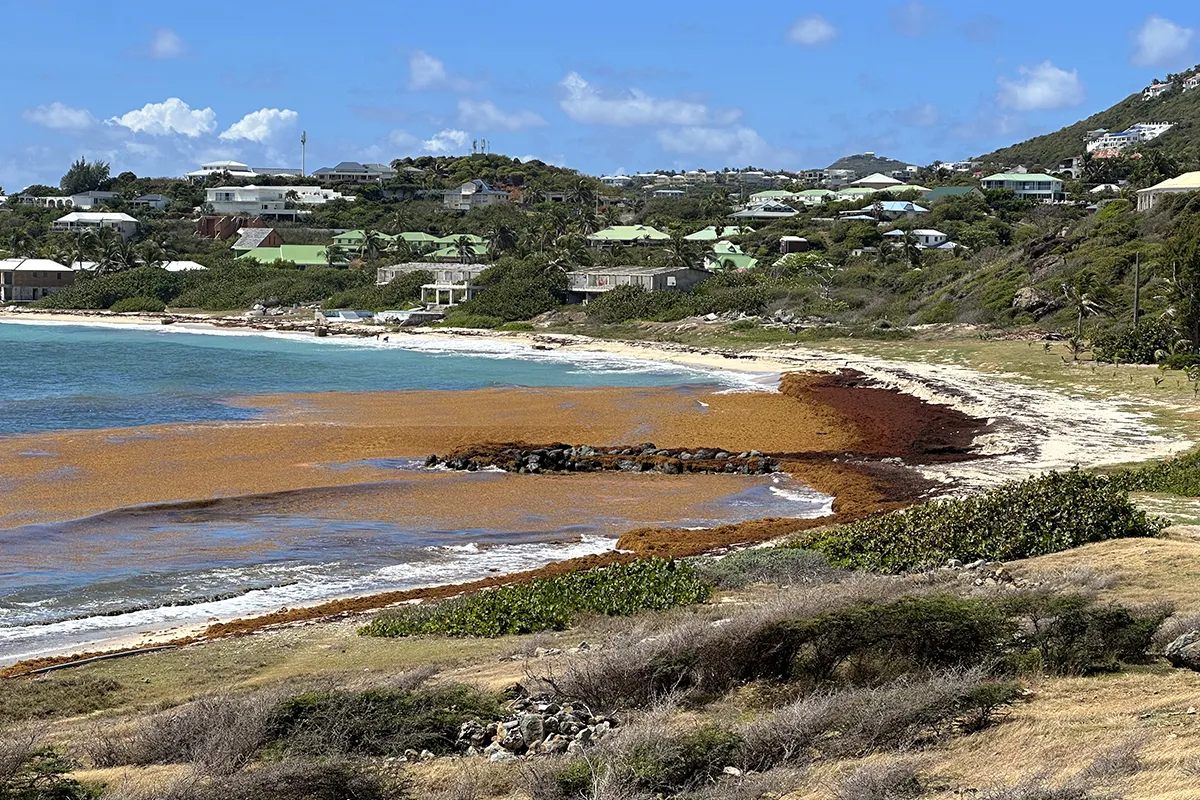
Although the hot weather season has not yet begun, sargassum has already started to appear along some coastlines, two months earlier than usual. This early arrival confirms scientists’ fears: 2026 could well be a record year.
The alarm was sounded as early as late February by researchers at the University of South Florida’s Optical Oceanography Lab. Their observations are clear: brown algae are appearing earlier, in greater quantities, and have already exceeded the levels observed in 2022, a record year for strandings.
14 million tonnes adrift
Satellite observations of the Great Atlantic Sargassum Belt estimate the amount of sargassum in the Atlantic at nearly 14 Mt. Other data, this time from Europe, indicate that this amount can, at certain peaks, reach 34 Mt (it was 2 Mt in 2011). This mass, which covers, according to the low estimate, around 0.4% of the ocean’s surface, is expected to increase further in the coming months.
A large portion is currently drifting near the Lesser Antilles. The western Atlantic alone contains more than 8 Mt. The Caribbean Sea is not far behind, with 1.5 Mt already present, mainly south of Hispaniola. In this context, the Northern Antilles, including Saint Martin, are on the front line. The latest projections place a large part of the region in a high-risk zone for stranding, alongside Puerto Rico, Cuba and the Yucatán Peninsula. One major unknown remains: the winds and currents, which will determine, as they do every year, which beaches are most affected. In any case, the influence of global warming is clear. The proliferation of Sargassum is now linked to nutrients in the ocean, which deep currents bring to the surface, rather than to deforestation in the Amazon or runoff from the Congo River.
Pitiful resources in the face of a massive bloom
The strandings raise issues relating to public health (toxic gas emissions during decomposition), the environment (disruption of coastal ecosystems) and the economy (impact on tourism and coastal activities), as well as causing nuisance for residents of the affected coastlines (damage to facilities).
At a regional level, managing Sargassum is already a major budgetary challenge. In Miami, for example, beach cleaning alone accounts for almost the entire maintenance budget. In Saint-Martin, last year’s budget was €1,817,262 (with a state contribution of €900,000) for 16,000 tonnes collected from beaches and processed at the Eco Site.
The deflector nets at Cul-de-Sac and the Étang aux Poissons (€1 million, of which €320,000 is funded by the State) are expected to be in place before the summer, the peak of the season. They will then require annual maintenance estimated at between €150,000 and €200,000, but should help to concentrate the seaweed and make it easier to collect. However, the reality on the ground imposes numerous constraints, such as the lack of tidal range, which means breaks in collection while waiting for the seaweed to settle again.
Despite the ingenuity of the ‘geo-inventors’, quick to propose multi-million-euro miracle solutions, their technical innovations do not seem capable of resolving an oceanic phenomenon of such magnitude, especially as they are rarely based on sound scientific principles.
Many local authorities have already trialled various schemes, sometimes before backtracking. The Court of Auditors has, moreover, concluded that whilst management in Saint-Martin is not exemplary, it nevertheless represents the best available option in the current context.
Man versus nature: a lost battle?
Collection is carried out mechanically by two contractors at the sites of Cul-de-Sac, Mont Vernon, l’Étang aux poissons, Baie Lucas and Galion (they are no longer collected at Grandes Cayes to serve as a turtle breeding area). The public contract, awarded until 2029, was scaled in 2023 based on health risks rather than to absorb the full volume of waste likely to wash ashore. For the time being, measurements indicate that emissions remain below health thresholds. The contract will certainly be reviewed, and contractors are upgrading their equipment somewhat, but it will never be enough. In the face of the intensifying phenomenon, the funds earmarked for 2027 have already been mobilised. No single local authority can, on its own, stem a global problem. The question therefore arises as to whether public money should continue to be used, to the detriment of other priorities. Ultimately, the issue will also be to rethink coastal development to reduce the exposure of populations… but this is already a reality in the face of another phenomenon: rising sea levels. Man seeks to tame nature, but nature always reclaims its rights, inexorably, and the time has passed for viewing the problem on our own small scale. We must be aware of the global picture of a planet in peril.