


In Marigot, reliquaries have been installed to address the overcrowding at the cemetery
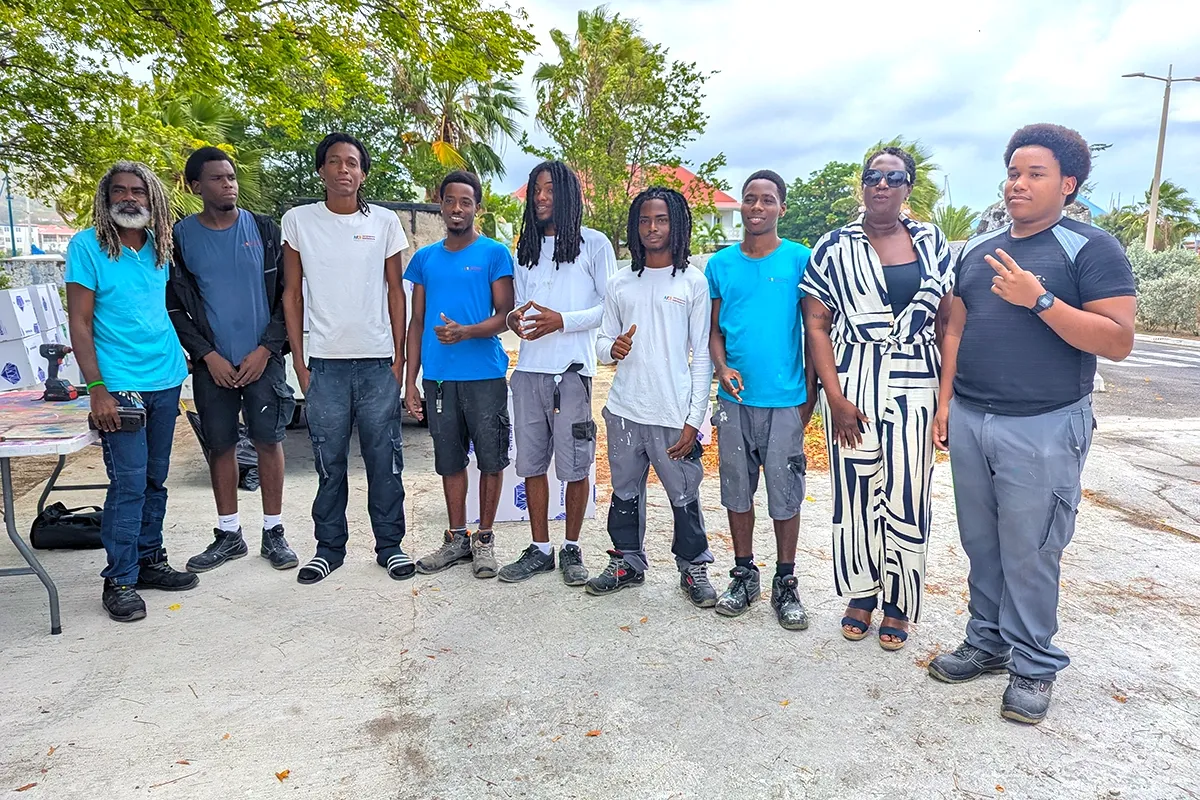
On Tuesday 23 June, at the Marigot-Sandy Ground cemetery, the Collectivité of Saint Martin and the Compagnons Bâtisseurs unveiled a number of reliquaries. Produced as part of a work integration scheme, these structures meet the cemetery’s modernisation needs.
Twelve young people on work integration schemes and 200 reliquaries: this is the outcome of the project carried out jointly by the Local Authority and the Compagnons Bâtisseurs. Unveiled on Tuesday 23 June, these measures are intended to address the issue of overcrowding at this memorial site. In a cemetery, a reliquary is used to hold human remains. In Marigot, these PVC containers will be stored in the ossuary inaugurated a few months ago. “The reliquaries will be used primarily in the pauper’s plot,” explains Bernadette Venthou-Dumaine, a territorial councillor. Families who wish to do so may also place the remains of their deceased loved ones in the ossuary. This work is part of a programme to modernise the island’s cemeteries led by the Territorial Collectivity.
A work integration scheme
Beyond addressing the issue of the cemetery’s overcrowding, the project has been designed as a vocational integration initiative. “The Territorial Collectivity wishes to create employment opportunities for young people in the region, in a sector where skills are in demand and where there are real prospects,” explains Bernadette Venthou-Dumaine. This project was successfully completed thanks to the work of twelve young people, at a total cost of 16,965 euros. Supervised by Hubert Hill, an engineer and vocational integration adviser with the Compagnons Bâtisseurs de Saint-Martin, they helped to make the reliquaries. “We began this initiative on 25 March. This allowed us to dedicate two days a week to the production project,” he explains. As part of this programme, the young people were able to learn about the trades of carpentry, as well as those within the funeral sector. At the end of the project, participants were awarded digital micro-certification badges. This recognition attests to their introductory training and may enable these young people to move on to more in-depth training following this initial experience.