


"Overseas territories are not peripheral territories."
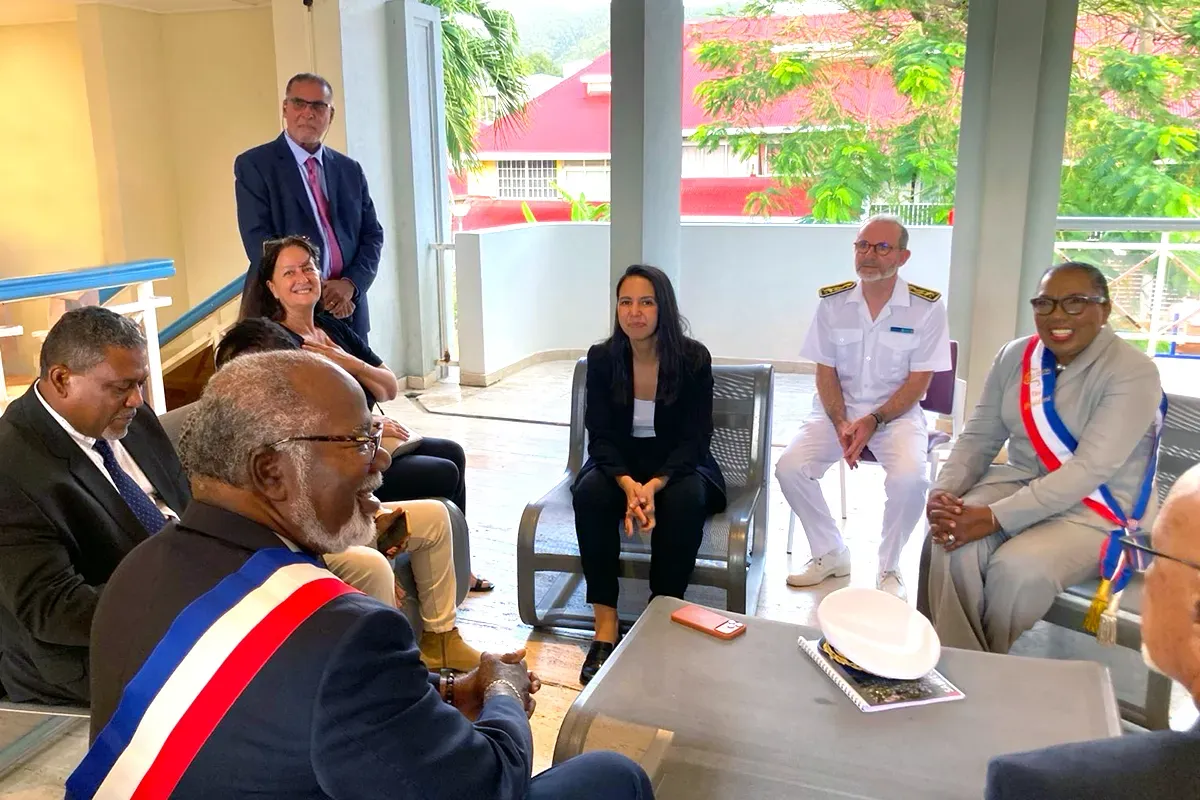
"We don't just visit territories in times of crisis, we also visit them to work together." This is how the Minister for Overseas Territories described her trip to the Northern Islands: an independent visit, not part of another trip, to discuss the priority issues for both territories: security, the economy, energy and the environment.
For Naïma Moutchou, overseas territories should not be considered peripheral: "They are integral parts of the Republic," she said, also highlighting their strategic importance for France's presence and sovereignty in the region. It was therefore with the aim of addressing specific issues and gauging local needs that she began her visit on Sunday with a meeting with elected officials, followed by a meeting with President Mussington.
Priority to local concerns
The aim of this first meeting, which focused on local concerns, was to discuss how to continue working with the State to build a better future for the population. The first issue was to resolve the housing crisis, for which the Minister undertook to look closely at what could be done. Indeed, Louis Mussington, given the societal challenges this represents, asked the Minister to review the single budget line of €1.8 million and to grant substantial aid to the Collectivité, which is planning to build 300 homes per year.
Another hot topic is energy, for which Naïma Moutchou gave an overview of the situation, with the President of the Collectivité outlining the difficulties. A meeting with the authorities and EDF was also scheduled with EDF in Saint-Barthélemy on Monday. She indicated that while the Prime Minister had made progress on energy issues with a multi-year energy plan, he was aware of the specific problems facing overseas territories. The issue is at the top of the pile, even if I can't reveal anything at this stage, she assured, "but we have taken the matter in hand".
Statutory changes were also discussed, because after 18 years of existence, "it is time to review the situation and give the Collectivité more resources and political leverage to better prepare for the future of the territory," commented Louis Mussington. According to the President, this change would be in line with the wishes of the President of the Republic. He gave the Minister a document listing all the measures that elected officials would like to see changed.
Finally, bilingualism was also at the centre of the discussions, for which President Mussington requested a meeting with the Minister of National Education to work on a draft agreement between the State, the National Education services and the Collectivity. The Minister will receive a copy of the draft so that she can give her opinion on the necessary measures to be taken with the Rector of Guadeloupe in order to significantly improve bilingual education in the territory.
Cooperation: first concrete results
Regional cooperation is also a topical issue, already underway with Saint Martin's accession to the OECS (Organisation of Eastern Caribbean States) because, according to the President, there is a card to be played. This cooperation also applies to security and will be formalised on Tuesday with the signing of an agreement with the Netherlands on the right of pursuit at sea. "This will enable coordination between our security forces in order to carry out interceptions at sea. Since this is a daily issue," said the Minister. On a shared island, this rather innovative cooperation will enable greater efficiency in the fight against drug trafficking.
This first day ended with a discussion with ten women from the territory as part of International Women's Rights Day. After visiting Saint Barthélemy on Monday, the minister is back in the territory today to sign the agreement with the Netherlands, attend a meeting at the RSMA and visit several associations in Quartier d'Orléans. More to follow in our next edition.