



Bathing water quality: 91.7 per cent of sites meet the standards
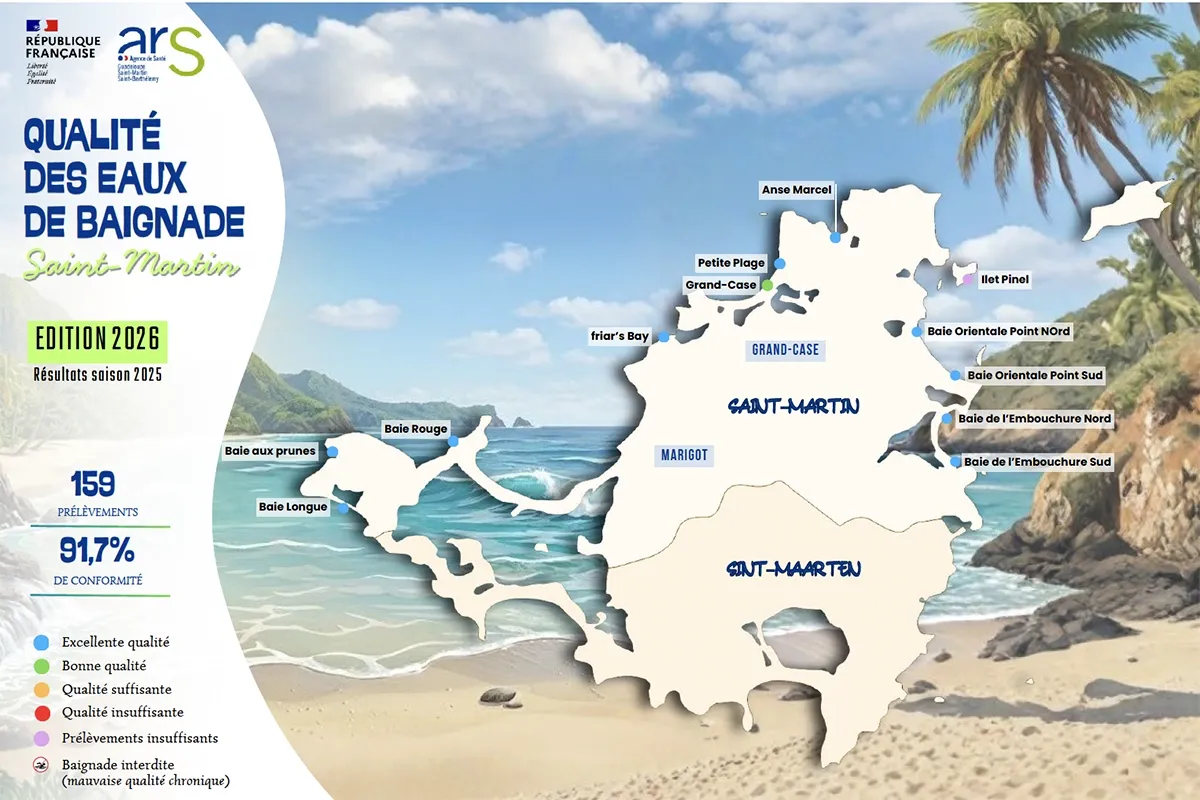
As it does at the start of every summer season, the Regional Health Agency (ARS) for Guadeloupe, Saint-Martin and Saint-Barthélemy publishes its report on water quality in the archipelago. In Saint-Martin, swimming conditions are almost idyllic : ten out of the eleven sites sampled have excellent water quality.
Under the Public Health Code and the European Directive, the ARS is responsible for monitoring the health and safety of bathing waters in order to protect the health of bathers. It also plays a supportive role in working with local authorities to prevent the risks of pollution and to improve the quality of bathing waters in a sustainable manner. In particular, it monitors: the presence of algae, mineral oils or tarry residues; litter and floating debris; the colour and clarity of the water; the possible presence of Sargassum; and weather and environmental conditions that may affect water quality. At the same time, samples are analysed by a laboratory accredited by the Ministry of Health to test for two bacteria indicative of faecal contamination: Escherichia coli and intestinal enterococci. These germs, even at low concentrations, can indicate the presence of other pathogenic micro-organisms, such as viruses, bacteria or parasites, which may cause gastroenteritis, ENT infections or skin irritations.
At least four samples are taken from each site per season. The quality of the bathing water is then assessed in two stages: first, the classification of each individual sample, followed by the site’s overall classification at the end of the season, based on the results from the last four years.
83.3% of sites rated ‘excellent’
1,312 samples (2,000 in 2024) were taken across the archipelago between October 2024 and September 2025 at 128 sites, including eleven in Saint-Martin. Guadeloupe has seen a decline in water quality, with only 86.4 per cent of its sites meeting standards – a figure almost identical to that of 2023 but down on last year’s figure (89.5 per cent). In Saint-Barthélemy, the results of the 226 water samples are more mixed, with eight beaches having excellent water quality, four having ‘good quality ’ (Corossol, Saint Jean, Lorient, Marigot) and one (Public) where the water quality is merely ‘sufficient’.
Saint Martin stands out as a top performer, having made progress. Based on the 159 samples taken, 83.3 per cent of bathing sites have excellent water quality (75 per cent in 2024): Baie aux Prunes, Baie Rouge, Baie Longue, Friar’s Bay, Petite Plage, Anse Marcel, Baie Orientale (North Point and South Point), and Baie de l’Embouchure (North and South). As in previous years, Îlet Pinel is not classified due to an insufficient number of samples. The only site in the French part of the island not rated as ‘excellent’ is Grand Case; however, the water there is generally considered to be of ‘good quality’. This issue will only be resolved once the sewage connection is fully operational.
What can be done to maintain this quality? Be more responsible, whether you are a swimmer, a boater (avoid emptying toilet waste whilst at anchor – it’s forbidden!) or a walker (pick up animal faeces on the beach), etc. It should be noted that the Collectivité is obliged to display these results at the sites concerned… which is not currently the case.
As for tap water, it is also monitored to ensure it is safe to drink. According to the same ARS report, Saint Martin’s water supply complies (bacteriological and physico-chemical compliance) with the current quality requirements for all parameters measured.