



Cadres d’Avenir: a helping hand for young people, an asset for the region
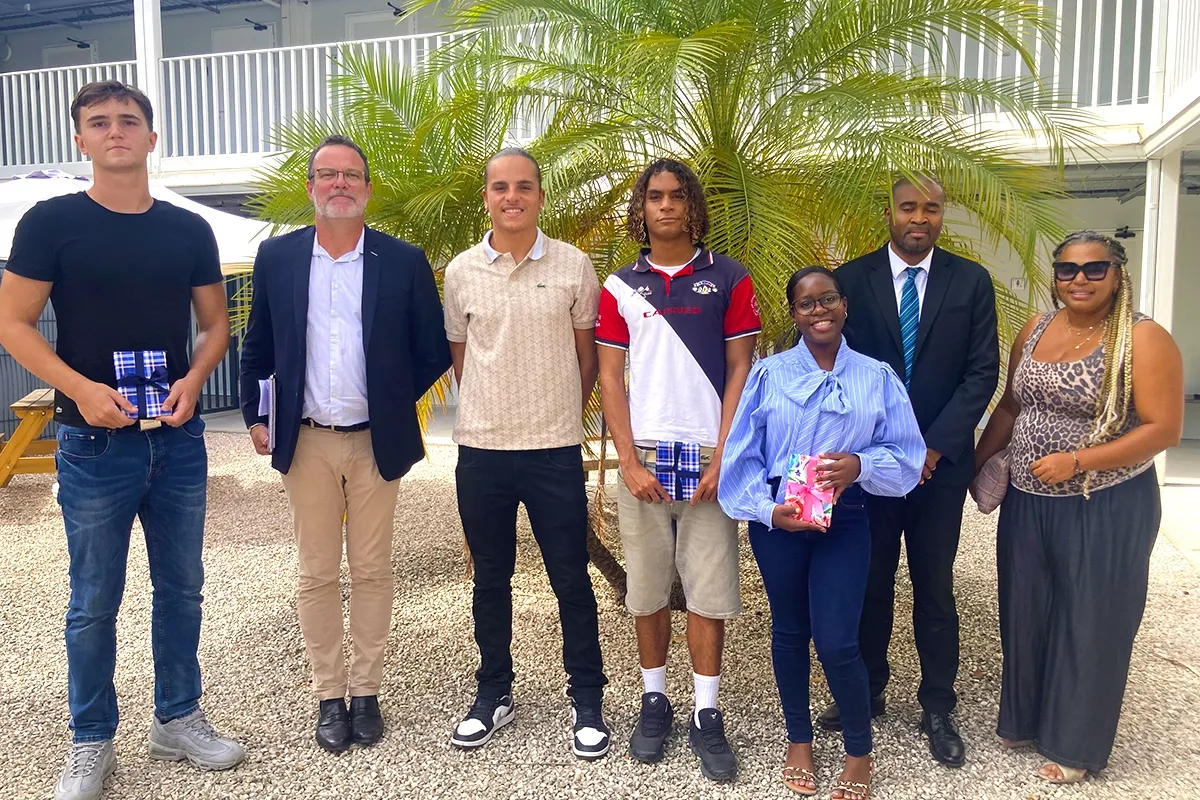
On 13 August, four young people signed their employment contracts as part of the ‘Cadres d’Avenir’ scheme. The scheme offers financial and educational support to enable them to continue their studies in France, with the aim of subsequently returning to put their skills to good use in their home region.
Originally designed for New Caledonia, the ‘Cadres d’Avenir’ scheme has been extended to other territories and launched in 2023 on a trial basis for a period of five years, until August 2028, in Guadeloupe, Martinique and Saint Martin. It supports young people under the age of 30 (secondary school pupils, university students or those returning to education) in pursuing their studies in mainland France, with a view to meeting the demand for middle and senior management in the territories concerned.
This initiative has been welcomed by the Prefecture’s Secretary-General, Fabrice Thibier, who benefited from it himself in his younger days. Originally from Réunion, he was indeed able to receive funding for a one-way ticket… Today, the scheme is much more substantial and, above all, better thought out.
Training future managers
Supported by the Collectivité de Saint-Martin and LADOM (the Overseas Mobility Agency), ‘Cadres d’Avenir’ includes a settlement grant of €800, the cost of a return flight each year and a flat-rate monthly allowance of €808. However, as Nesly Dolne, LADOM’s representative for the Northern Islands, pointed out, beneficiaries also receive administrative and educational support from a dedicated contact person, as well as guidance during their transition into the workforce. This represents significant financial assistance for families and vital support for young people who find themselves ‘expatriates’, often facing difficulties in adapting.
Candidates are selected from those who have already obtained a qualification and have a career plan in one of the sectors experiencing recruitment difficulties. For the Class of 2026, four young A-level graduates – selected for their academic record, motivation and career plans – signed their employment contracts before flying to mainland France. A “solemn” moment for Agnès Lautone, head of the DEETS’ regional office, as these young people are embarking on a long process with a commitment to serving Saint-Martin.
Leaving to return stronger
The only young woman this year, Thaïra Samer hopes to become an architect, but she has initially opted to study civil engineering in Bourges in order to acquire a solid foundation, particularly in the field of structural renovation, which she believes is necessary given the territory’s needs. Another sector facing a shortage of skilled workers is the construction industry. This is the path chosen by Keanu Rapin, who will be heading to Anglet to study for a BTS qualification with the aim of returning as a site manager or foreman. The other two candidates, meanwhile, have decided to focus on a thriving sector – tourism – and will begin a course in hospitality and catering at the start of the new academic year. Gabriel Cadiou will enrol at the Médéric school in Paris and Mathéo Ginkels at Vatel in Bordeaux. These are two recognised institutions in this field, which should provide them with the necessary training to open their own establishments upon their return.
In return, they have committed to returning to work in Saint-Martin once they have completed their training. However, this timeframe is considered somewhat short, as in practice, as Fabrice Thibier points out, students often need to complete a final-year work placement. This view is shared by Junisa Gumbs, Chief of Staff to the President of the Collectivité, who has supported the roll-out of the scheme in Saint Martin since its inception, and who has indicated that discussions are underway to ensure, on a case-by-case basis, allow future executives time to gain initial professional experience before their return. It should be noted that financial assistance from Cadres d’Avenir can be combined with the APL (personalised housing allowance) and the grant awarded by the Collectivité for higher education (up to doctoral level).