



Ministerial visit: a Franco-Dutch agreement to step up the fight against drug trafficking
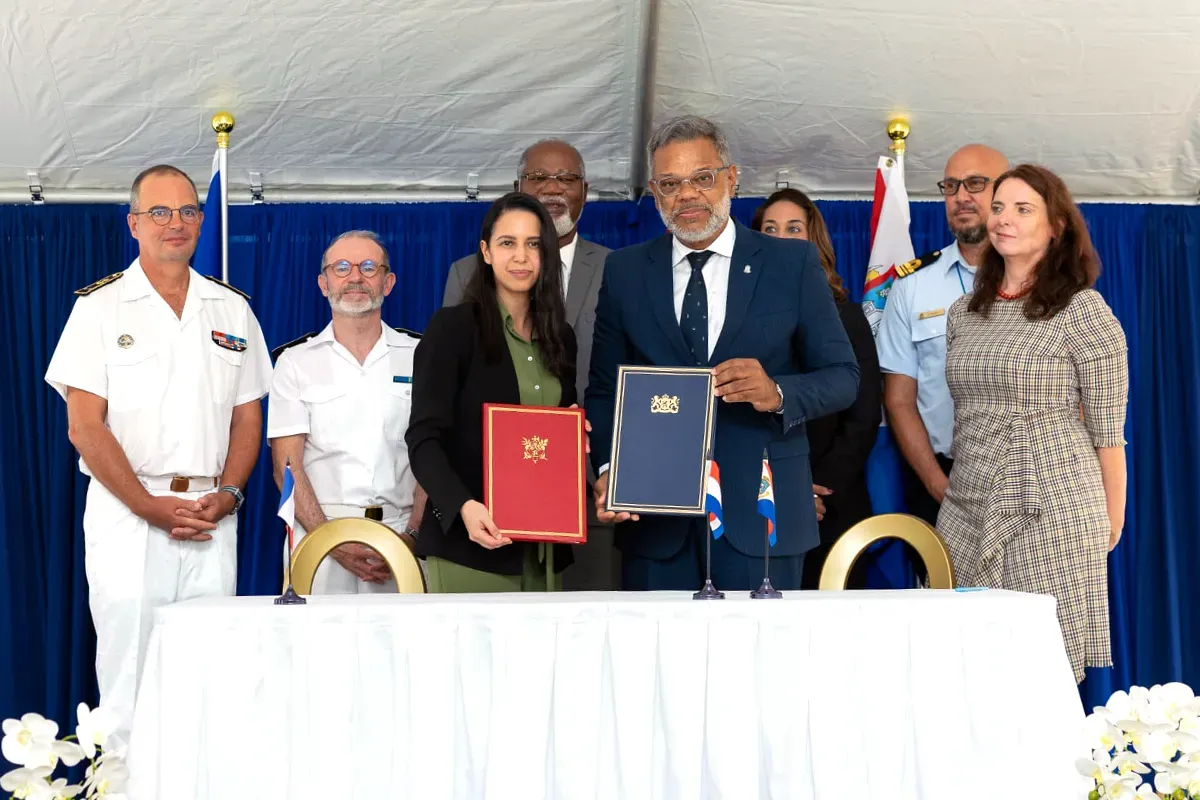
“The signing of this agreement between France and Sint Maarten is not merely a legal instrument. It is a political and strategic act.” It was with these words that the Minister for Overseas Territories, Naïma Moutchou, opened her speech on Tuesday during the signing of a cooperation agreement with the Prime Minister of the Dutch part of the island, Luc Mercelina.
In response to the rise in illicit trafficking in the Caribbean, particularly drug trafficking, France and Sint Maarten intend to strengthen their coordination. Criminal networks exploit the island’s geography, the porous nature of maritime borders and the speed of vessels to evade checks.
To address this situation, the agreement provides for a strictly regulated mutual right of pursuit at sea, where one of the parties is unable to intervene immediately. The text guarantees respect for each party’s sovereignty: no police action may be carried out in the territorial waters of the other party, and the use of force is limited to self-defence. Permanent notification mechanisms, 24-hour contact points and regular exercises are also provided for to improve operational coordination.
The minister clarified that, beyond the fight against trafficking, cooperation between the two parts of the island extends to other issues identified at the 2023 quadripartite meeting: security, migration, as well as infrastructure, water management, waste treatment, health and education. The government’s stated aim is to make Saint-Martin a model of regional cooperation in the Caribbean.
A regional ambition
According to Naïma Moutchou, France wishes to develop, alongside its European and Caribbean partners, a European training academy to combat drug trafficking in Santo Domingo. This initiative would aim to strengthen specialised training, intelligence-sharing and inter-agency cooperation in the face of increasingly structured and transnational criminal networks.
It is in this same spirit that a regional conference dedicated to security challenges in the Caribbean will be organised in Martinique in July. This meeting will bring together the states and territories affected by the common challenges of drug trafficking, organised crime, maritime security and crisis resilience. The Netherlands will naturally be invited as a major partner in the region.
“Their experience, commitment and presence in the Caribbean are essential to regional balance and stability. We hope that this conference will further strengthen coordination between our services, enable the sharing of best practices and identify new avenues for operational cooperation,” concluded the Minister for Overseas Territories during her address at the Cole Bay police headquarters, where this cooperation agreement – described as historic – was signed.