


A new term marked by a spirit of solidarity
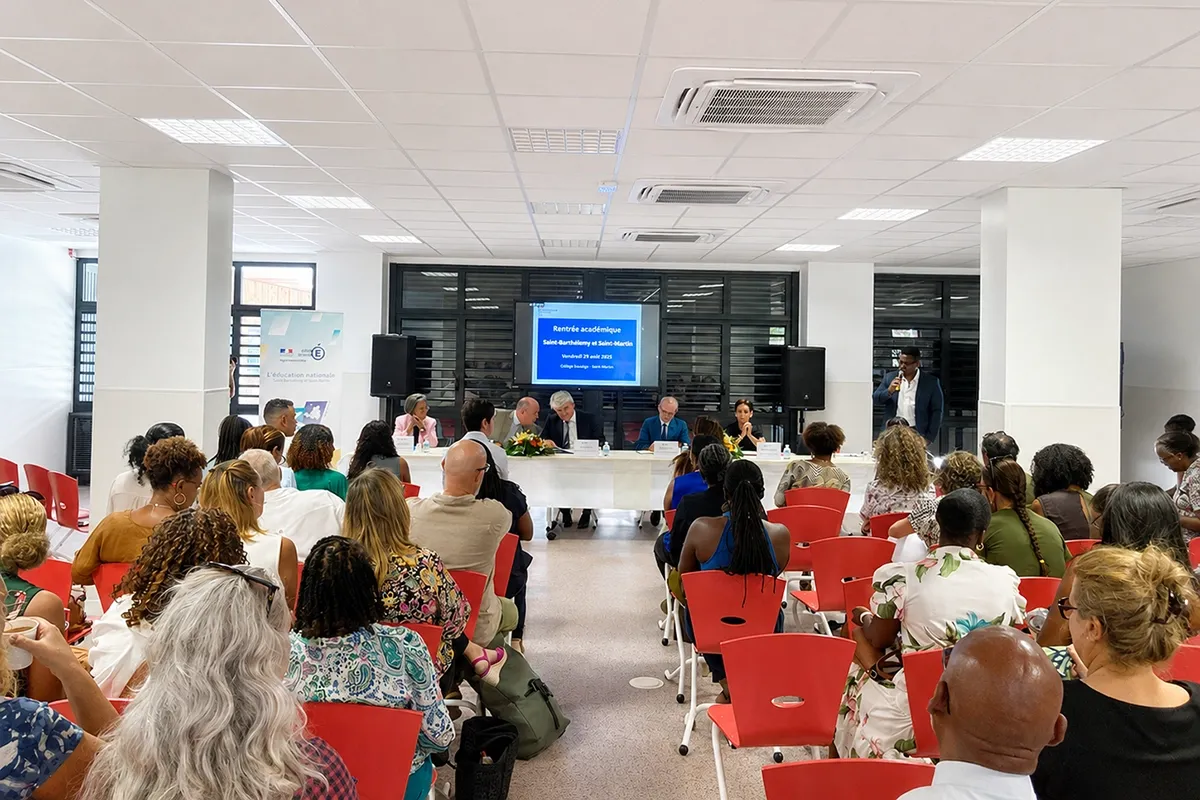
The rector, the Secretary-General of the Academy and the Deputy Academic Director of National Education Services had travelled to the territory on Friday to oversee the start of the new academic year for senior management and administrative staff, alongside the Vice-Rector and the Prefect of Saint-Barthélemy and Saint-Martin.
The morning was devoted to presenting the teaching and educational outlook, as well as the priorities set for this new school year, which will be characterised by commitment, cooperation and collective action.
For the rector, Gabriele Fioni, “educating the girls and boys who will build the future is becoming increasingly difficult, and the coming year will be a challenging one: difficult material conditions, staff who are increasingly overburdened, a shortage of teaching materials and a certain gloom that is beginning to set in. ’ Faced with these difficulties, he urged staff not to tackle them alone and to alert the Vice-Rector in the event of a major problem, so that situations can, if necessary, be brought to the attention of the Prefect.
But, he emphasised, we must still have the collective will to bring about change. Everyone must put their heart into it and bear in mind that we are all working towards the same goal. In particular, he called for more humanity to be brought into professional relationships, including in administrative procedures, for staff to work as a team, and for staff to be given greater recognition.
“ ‘Kindness is the starting point,’ he summarised, without, however, compromising on compliance with the rules: unacceptable behaviour must not go unchallenged.
Another key priority is the fight against illiteracy. In the French West Indies, one in four young people is thought to be affected, which is twice the national average. According to the rector, this finding calls for a stronger commitment from the Ministry of Education, particularly when families are themselves unable to provide sufficient support for their children’s learning.
The challenge is therefore to strengthen the acquisition of basic skills and to ensure that no pupil becomes permanently stuck with difficulties in reading and writing.
The Prefect, Cyrille Le Vély, for his part, highlighted the unique institutional status of the Northern Islands. According to him, Saint Martin and Saint Barthélemy are territories that are ‘not yet stabilised’ and which require ongoing institutional review. Some changes are being called for, whilst others are already underway or under consideration. He therefore urged local stakeholders to continue this discussion without confining themselves to the existing institutional framework.
With regard to educational and cultural resources, the Prefect also emphasised that Saint-Martin will soon enter a new era with the opening of the media library. Until then, the Department for Education must continue to fulfil its role fully to provide pupils with access to the necessary resources.
Human resources and digital security
The Academy’s Secretary-General, Olivier Huisman, emphasised the need to strengthen local human resources management. Clear organisational charts, up-to-date job descriptions and annual appraisals: these are all prerequisites which, he acknowledged, are not yet always fully implemented.
Digital security is also a major concern. With 11.8 million pupils, plus parents, local authorities and all the institution’s partners, the National Education System is a particularly vulnerable target. A message urging vigilance has therefore been issued to administrative staff regarding the use of digital tools and data protection.
This new school year is also marked by recruitment difficulties. This is a challenge that cannot be overcome in the short term alone. For academic leaders, teachers also have a role to play in inspiring vocations and encouraging younger generations to join the National Education Service in the future.
Alarming indicators
The Vice-Chancellor, Nicole Noilhetas, outlined the key issues she intends to tackle: strengthening the acquisition of fundamental skills, promoting and developing multilingualism, combating school drop-out rates and working towards a more harmonious school environment. These are themes she had outlined upon her arrival (see our edition of 28 July). To begin with, she set out the background context for the region: pupil numbers continue to fall, with 112 fewer pupils at the start of this academic year (39 in primary education and 73 in secondary education). Unfortunately, this decline is also reflected in assessment results: a cohort study conducted since 2022, covering Years 1 to 4, highlights very poor results over the last five years, widening the gap with the Academy average, and which are evident on entry to Year 7, particularly in French and mathematics. Results are also sluggish for the Brevet, CAP and vocational Baccalaureate, falling well below national averages. The general Baccalaureate, however, performs well, with generally good results. The key challenge will therefore be to improve these figures, with a particular focus on preventing pupils from dropping out. Currently, it is estimated that 6 per cent of secondary school pupils – that is, 237 pupils (43 per cent of whom are girls) – are at risk of dropping out, and 177 have already been identified as having dropped out with no alternative arrangements. Only 35 are in training or employment.
Finally, regarding the school environment, 113 incidents were reported across all schools, half of which occurred in primary schools. Nearly 60 per cent of these incidents involved physical or verbal abuse directed at teachers or between pupils.
A meeting is scheduled later this month with headteachers and the deputy head of the local education authority to discuss in detail all the issues raised during this morning’s session. Another highlight of the start of the new school year is the ‘Septembre Bouge’ initiative on 16 September, when sport will be introduced into all schools.