



Air Antilles: the curtain has fallen, but the story continues
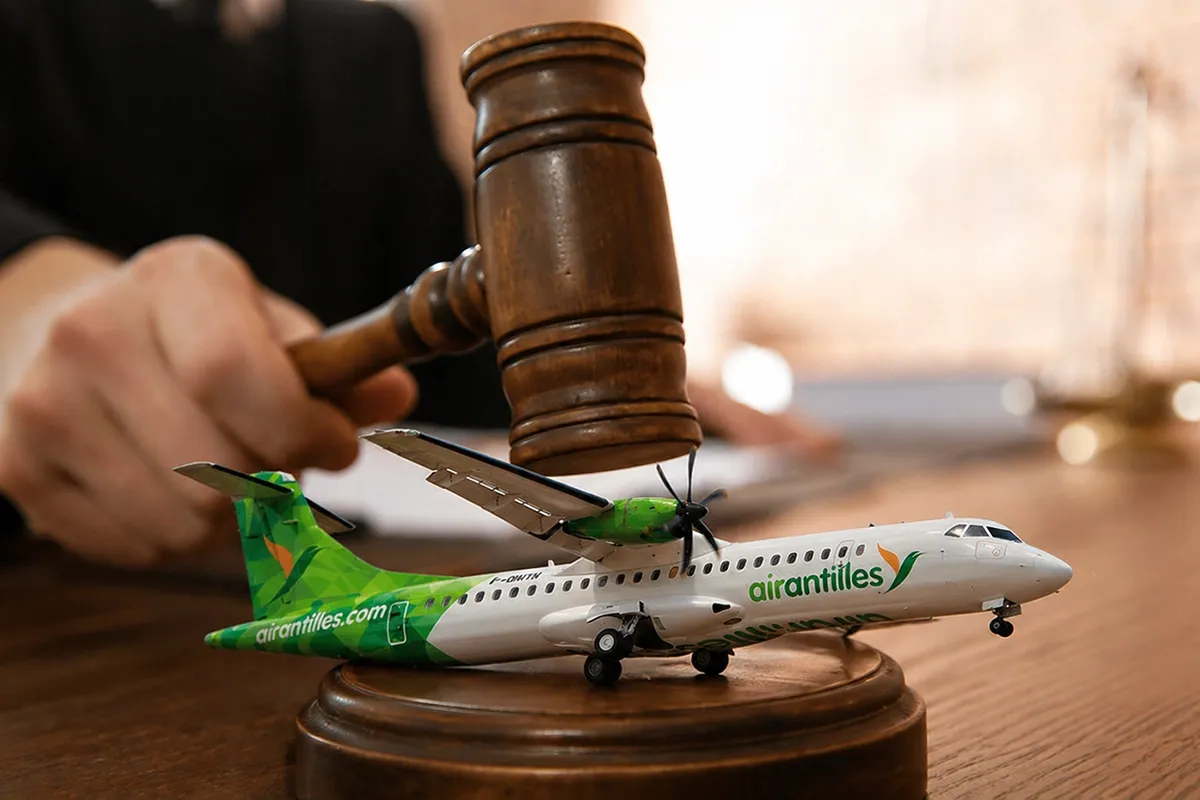
On Monday, the Joint Commercial Court of Pointe-à-Pitre ordered the compulsory liquidation of Air Antilles, with all operations ceasing immediately. This decision has far-reaching consequences for the Collectivité of Saint-Martin, its elected representatives and its residents.
Air Antilles, which has been in suspension of payments since January and is now in compulsory liquidation, will not be taken over by a buyer. The court ruled that no takeover bid was robust enough to ensure the continuation of the business. In Guadeloupe, 116 employees will join the ranks of France Travail. In Saint-Martin, some 31,000 residents will bear the financial consequences. Following the deliberations, President Mussington indicated that he did not wish to comment at this stage.
Chronicle of a death foretold
By taking over Air Antilles in September 2023, the Collectivité became the airline’s majority shareholder with a 60% stake, inheriting a fleet of aircraft in poor condition and a mountain of debt. The opposition contested the plan at the time, fearing a financial black hole, but to no avail. It was not until July 2024 that the first aircraft landed at Grand Case, and the airline was then operating with a single ATR, the other two being overhauled in Morocco. Between licence revocation, a provisional licence and flight suspensions, the airline has consistently struggled to achieve financial stability. An initial claim of €3.7 million has been filed with the Commercial Court of Pointe-à-Pitre… but the total amount of the debts is not precisely known, and that is precisely one of the problems. Over the months, the company’s management has become highly opaque. The opposition MPs had requested the figures. The President had replied, “It will come”… but it never did.
Who is footing the bill?
The financing of Air Antilles cost €16.4 million, part of which was spent on staff costs. The aircraft required €3 million in repairs. Added to this were €2 million for the creation of Air Antilles’ capital, €6 million for the associated current account contribution, and a second loan of €4 million (criticised by the Regional Chamber of Accounts, which already saw this as a significant financial risk) to SEM Air Antilles to meet the requirements of the Directorate General of Civil Aviation to retain the operating licence. The President had stated, at the territorial council meeting on 7 August 2025, that the Collectivité would not invest a single cent more in the company. On 3 October 2025, a new €3 million loan was approved to support the company’s recovery and development plan. On 14 October 2025, France Info revealed that more than €24.5 million in aid (i.e. public money) had been allocated to the airline in less than two years.
Today, what is the exact amount of liabilities (supplier debts, tax debts, social security debts, aircraft leasing, etc.), and who are the creditors? The cumulative debts of SEM Air Antilles are estimated at €25.35 million and operating debts at nearly €9 million, more than half of which is owed to suppliers and airports (€243,000 to Grand Case airport as of late August 2025) and less than a third to the DGAC. Two aircraft are financed by bank loans and one by a lease. As for the amount owed to passengers, it would appear that any hope of reimbursement has vanished with the liquidation.
The figures, released sparingly at the whim of the territorial councils, make it difficult to tally up the total, but some sources report liabilities of around €56 million. At the last territorial council meeting in February, a derisory risk provision of €1.4 million was included in the 2026 draft budget. The opposition had also noted that the potential loss of funds committed to SEM Air Antilles had been deliberately omitted from the budget policy report.
Senator demands the truth
Senator Annick Pétrus, even before the liquidation was announced, had spoken on Radio Saint-Martin. “It is not so much the takeover of the company that bothers me, but the improper way in which public money has been managed” (as a reminder, she had not taken part in the vote on the latest loan). She criticises the lack of transparency, particularly regarding the financial audit which was never shared with elected representatives, and demands to know the truth about how this money was used. She regrets that this financial loss is affecting a large number of projects in the territory and, consequently, the population.
When issues regarding changes to the company’s status or management were raised by opposition councillors, who sounded the alarm, it was already too late, she laments. The intention was laudable, but the laissez-faire approach has gone too far. Whilst the financial consequences are inevitable, Annick Pétrus believes there must also be legal consequences, as she is convinced that certain individuals have taken advantage of the situation, citing as an example the €8 million in expenditure for which there are no supporting invoices. “This is the end of the debate, but it is not the end of the story,” concluded the senator.
An airline’s dependence on public funds is a prime example of the system’s failings, where political considerations take precedence over economic reason. Territorial continuity in no way justified this financial headlong rush for an airline that never took off and ultimately changed nothing in the skies over the Caribbean.
As for the impact of this episode on the upcoming territorial elections, it is the voters who will decide whether they forgive this reckless management… or not.